
Lose Weight and Gain Muscle at the Same Time: The Body Recomposition Blueprint
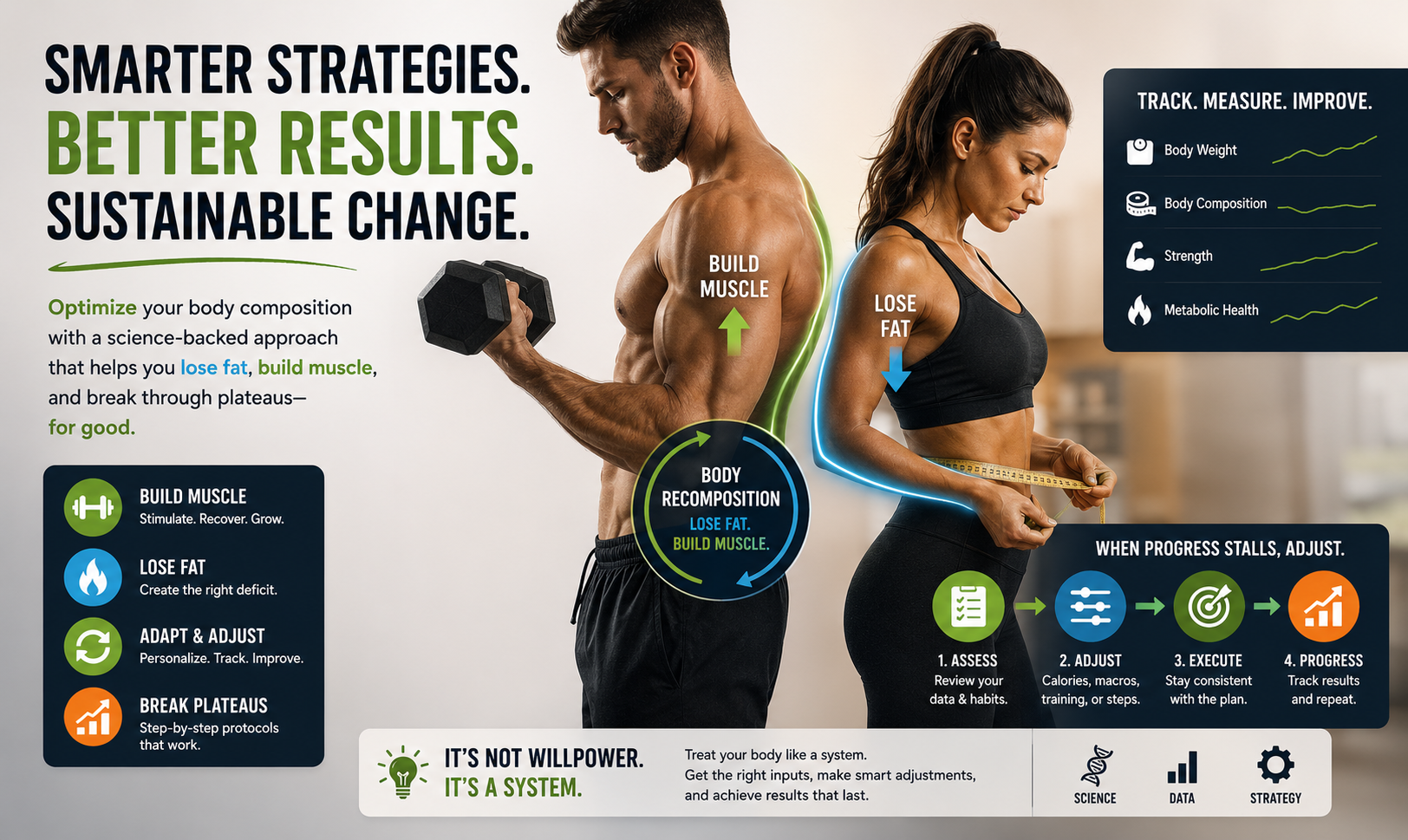
If you want to lose weight and gain muscle at the same time, you need to stop thinking about weight loss as a test of willpower and start treating it as a measurable biological system. Most weight loss programs focus only on the scale, ignoring the muscle tissue that drives long-term metabolic health. Body recomposition — simultaneous fat loss and muscle gain — is achievable when you track the right inputs: protein intake, training stimulus, and recovery. This guide breaks down the science and gives you a step-by-step protocol for exactly what to adjust when progress stalls.
Why "Willpower" Is the Wrong Framework
Most people who try to lose weight and gain muscle are told the same thing: eat less, move more, and stay disciplined. That advice treats fat loss as a moral test instead of what it actually is — a biological process governed by measurable inputs and outputs. When you frame body composition change as a willpower problem, every stall feels like a personal failure. When you frame it as a system, every stall becomes a data point that tells you exactly what to adjust next.
What "Metabolic Agility" Actually Means
Metabolic agility is your body's ability to switch efficiently between burning fat and burning carbohydrates for fuel, depending on what's available and what you're doing. A metabolically agile body can tap into stored fat during a calorie deficit while still preserving — and even building — muscle tissue when resistance training and protein intake are dialed in correctly. This is the physiological foundation of body recomposition, and it's why the same calorie deficit produces wildly different results depending on training status, protein intake, and sleep quality.
Can You Really Build Muscle in a Calorie Deficit?
Yes — under specific conditions. Research on body recomposition consistently shows that beginners, people returning after a long training break, and individuals carrying extra body fat can gain muscle while losing fat simultaneously, a phenomenon often called "newbie gains" or "detraining recomp." The trigger is a strong resistance-training stimulus combined with adequate protein (generally 0.7–1g per pound of goal body weight) even while total calories sit below maintenance. More advanced lifters generally need a slight surplus to build muscle, but they can still hold onto lean mass aggressively while cutting fat — which is a recomposition win in itself.
Why Generic Weight Loss Programs Fail at This
Most commercial weight loss programs are optimized for one number: pounds lost per week. That single metric rewards muscle loss just as much as fat loss, because muscle is heavier than the water and glycogen swings that dominate early "successful" weeks. A program built around body recomposition instead tracks body fat percentage, strength numbers, and circumference measurements alongside the scale — because a body that keeps its muscle burns more calories at rest and looks visibly leaner at any given weight. Before starting any plan, it helps to know your realistic target range using a tool like FitMotif's ideal weight calculator, which accounts for frame size and height instead of a single generic number.
The Step-by-Step Stall Protocol
The single highest-engagement piece of information people search for isn't "how to start" — it's "what do I do when nothing is working anymore." A weight loss stall is normal and predictable, not a sign that your plan has failed. Here is the exact sequence to follow when the scale hasn't moved in two to three consecutive weeks despite consistent effort.
Step 1: Audit Before You Cut Calories Further
Before touching your food intake, verify your inputs for 7 days: track every gram of food, weigh yourself at the same time each morning, and confirm training sessions actually happened as planned. A large percentage of "stalls" are logging drift, not metabolic adaptation. Compare your current weight against your ideal weight calculator target to confirm you still have meaningful fat to lose versus approaching a genuinely lean, harder-to-move range.
Step 2: Check Non-Scale Markers First
If logging is accurate, check progress photos, waist circumference, and strength logs before adjusting calories. It's common to lose fat and gain muscle in the same week, producing a flat scale reading with visibly tighter clothing and heavier lifts. This is body recomposition working exactly as intended — the scale is simply the least sensitive tool in your kit during this phase.
Step 3: Make the Smallest Effective Adjustment
If two full weeks of accurate tracking confirm a genuine stall, reduce calories by 5–10% rather than making a drastic cut, or add 1,500–2,000 steps per day before touching food at all. Small, incremental changes preserve muscle-protecting hormones and appetite regulation far better than aggressive cuts, which tend to trigger the exact muscle loss that undermines a lose weight and gain muscle goal in the first place.
Step 4: Reassess Training Volume Every 4–6 Weeks
Muscle growth requires progressive overload — gradually increasing weight, reps, or sets over time. If your lifts have been flat for over a month, the stall may be a training problem, not a nutrition problem. Add one working set to your main lifts or increase load by 2–5% before assuming the issue is dietary.
Step 5: Schedule a Diet Break
Every 8–12 weeks of sustained deficit, take 1–2 weeks at maintenance calories. This restores hormone levels tied to hunger and metabolic rate, improves training performance, and makes the next phase of fat loss more effective — a strategy backed by research on long-term weight loss programs adherence and outcomes.
Building the Recomposition-Ready Plan
Once the stall protocol is in place, the underlying plan needs three components working together: a modest calorie deficit, a resistance-training program with progressive overload, and enough protein and sleep to support muscle repair. None of these work in isolation — cutting calories without lifting sacrifices muscle, and lifting without adequate protein blunts recovery regardless of how hard you train.
Nutrition Targets That Actually Support Muscle Retention
Aim for a deficit of 300–500 calories below maintenance — steep enough to lose fat steadily, mild enough to protect training performance. Set protein at 0.8–1g per pound of goal body weight, prioritize it at each meal, and let carbohydrates and fats fill the remaining calories based on personal preference and training demands. This structure outperforms most generic weight loss programs precisely because it protects the tissue that keeps your metabolism running efficiently.
Training Structure for Recomposition
Resistance train 3–5 times per week, hitting each major muscle group at least twice weekly. Prioritize compound lifts — squats, deadlifts, presses, rows — and track your numbers every session. Cardio is useful for supporting the calorie deficit and cardiovascular health, but it should supplement, not replace, the resistance training that drives the muscle-building side of body recomposition.
Tracking Metrics Beyond the Scale
Weigh in daily and use a 7-day rolling average to smooth out water fluctuations. Take progress photos every two weeks in consistent lighting and clothing. Log your top working sets so strength trends are visible over time. Together, these markers tell a far more accurate story than a single number ever could, and they're what separate a sustainable recomposition plan from another short-lived attempt at generic weight loss programs.
Common Mistakes That Stall Progress
The most frequent errors are cutting calories too aggressively out of impatience, skipping progressive overload once initial motivation fades, under-eating protein while over-restricting overall calories, and abandoning the plan the moment the scale plateaus instead of running the stall protocol above. Recomposition is a slower visual process than pure weight loss, so patience with non-scale markers is what ultimately determines success.
Frequently Asked Questions
Can I really lose weight and gain muscle at the same time?
Yes, particularly if you're new to resistance training, returning after time off, or currently carrying more body fat than your target range. A calorie deficit combined with adequate protein and consistent resistance training allows the body to draw energy from fat stores while still building muscle tissue.
Why has my weight loss stalled even though I'm doing everything right?
Stalls are usually caused by tracking drift, water retention, or a body recomposition effect where fat loss and muscle gain offset each other on the scale. Follow the five-step stall protocol above: audit your logging, check non-scale markers, make a small calorie or activity adjustment, reassess training volume, and schedule a diet break if the deficit has been sustained for months.
How is body recomposition different from typical weight loss programs?
Typical weight loss programs optimize for scale weight alone, which rewards muscle loss as much as fat loss. Body recomposition tracks body fat percentage, strength, and measurements together, protecting the muscle tissue that keeps your metabolism efficient long after the program ends.
How much protein do I need to gain muscle while losing fat?
Most research supports roughly 0.8–1g of protein per pound of your goal body weight per day, spread across meals, to maximize muscle protein synthesis during a calorie deficit.
Conclusion
Learning to lose weight and gain muscle at the same time comes down to treating your body as a system you can measure and adjust, not a test of discipline you either pass or fail. Track your inputs, follow the stall protocol when progress flattens, and lean on tools like the FitMotif ideal weight calculator to set a realistic target. Skip the generic weight loss programs built around the scale alone, and build a plan around the muscle-protecting fundamentals that actually drive lasting body recomposition.