
Daily Calorie Intake: How Many Calories Do You Actually Need?

"How many calories should I eat?" is one of the most searched nutrition questions on the internet — and one of the most consistently misunderstood. Generic answers like "2,000 calories a day" are population averages that may be meaningfully off for your individual body. Your real daily calorie intake requirement is shaped by your age, biological sex, height, weight, and how active you actually are. Get it right and it becomes the most powerful lever you have for managing your weight, energy levels, and long-term health. Get it wrong — even slightly — and months of effort can produce results that don't match your expectations.
What Is a Calorie — And Why Does the Number Matter So Much?
A calorie is a unit of energy. In nutrition, the term refers specifically to a kilocalorie (kcal) — the amount of energy needed to raise one kilogram of water by one degree Celsius. When a food label says a meal contains 600 calories, it contains 600 kilocalories of chemical energy that your body can extract and use for everything from fuelling your muscles during a workout to maintaining your heartbeat while you sleep. The typical daily calorie intake figure on food packaging — often shown as 2,000 or 2,500 kcal — is a reference average, not a personal prescription.
Calories matter because energy balance drives body weight. Consume more than you expend consistently, and you store the excess as body fat. Consume less, and your body draws on stored fat (and to some degree, protein) to make up the shortfall. This relationship is well-established in the research literature — as confirmed by organisations including the NHS and the USDA Dietary Guidelines for Americans. But calories are not the whole story — food quality, macronutrient composition, meal timing, hormonal factors, and gut microbiome all influence how efficiently those calories are used. That said, getting your daily calorie intake requirement right is still the non-negotiable foundation of any nutrition strategy.
Typical Daily Calorie Intake by Age and Biological Sex
The typical daily calorie intake varies considerably across life stages and between men and women. The figures below are based on the USDA Dietary Guidelines for Americans and represent estimated calorie needs at three broad activity levels: sedentary (little or no exercise), moderately active (light movement most days), and active (vigorous activity most days). These are useful orientation points — your personal figure requires a more precise calculation covered in the next section.
| Age | Sedentary | Moderately Active | Active |
|---|---|---|---|
| 19–25 | 2,000 | 2,200 | 2,400 |
| 26–30 | 1,800 | 2,000 | 2,400 |
| 31–50 | 1,800 | 2,000 | 2,200 |
| 51–60 | 1,600 | 1,800 | 2,200 |
| 61–70 | 1,600 | 1,800 | 2,000 |
| 71+ | 1,600 | 1,800 | 2,000 |
| Age | Sedentary | Moderately Active | Active |
|---|---|---|---|
| 19–25 | 2,600 | 2,800 | 3,000 |
| 26–30 | 2,400 | 2,600 | 3,000 |
| 31–50 | 2,200 | 2,400 | 2,800 |
| 51–60 | 2,200 | 2,400 | 2,600 |
| 61–70 | 2,000 | 2,200 | 2,600 |
| 71+ | 2,000 | 2,200 | 2,400 |
Notice the consistent downward trend with age in both tables. This reflects the gradual loss of lean muscle mass that occurs from the mid-30s onward — a process called sarcopenia — which reduces the body's resting calorie burn. It also means that the typical daily calorie intake that kept you at a healthy weight at 30 may lead to gradual weight gain by 45 if nothing else changes. Staying active, and particularly maintaining muscle through resistance training, is the most effective way to slow this shift.
These tables are general estimates. For a number personalised to your exact height, weight, age, and activity level, use our free calorie calculator and get your precise daily calorie intake requirement in seconds.
How to Calculate Your Personal Daily Calorie Intake Requirement
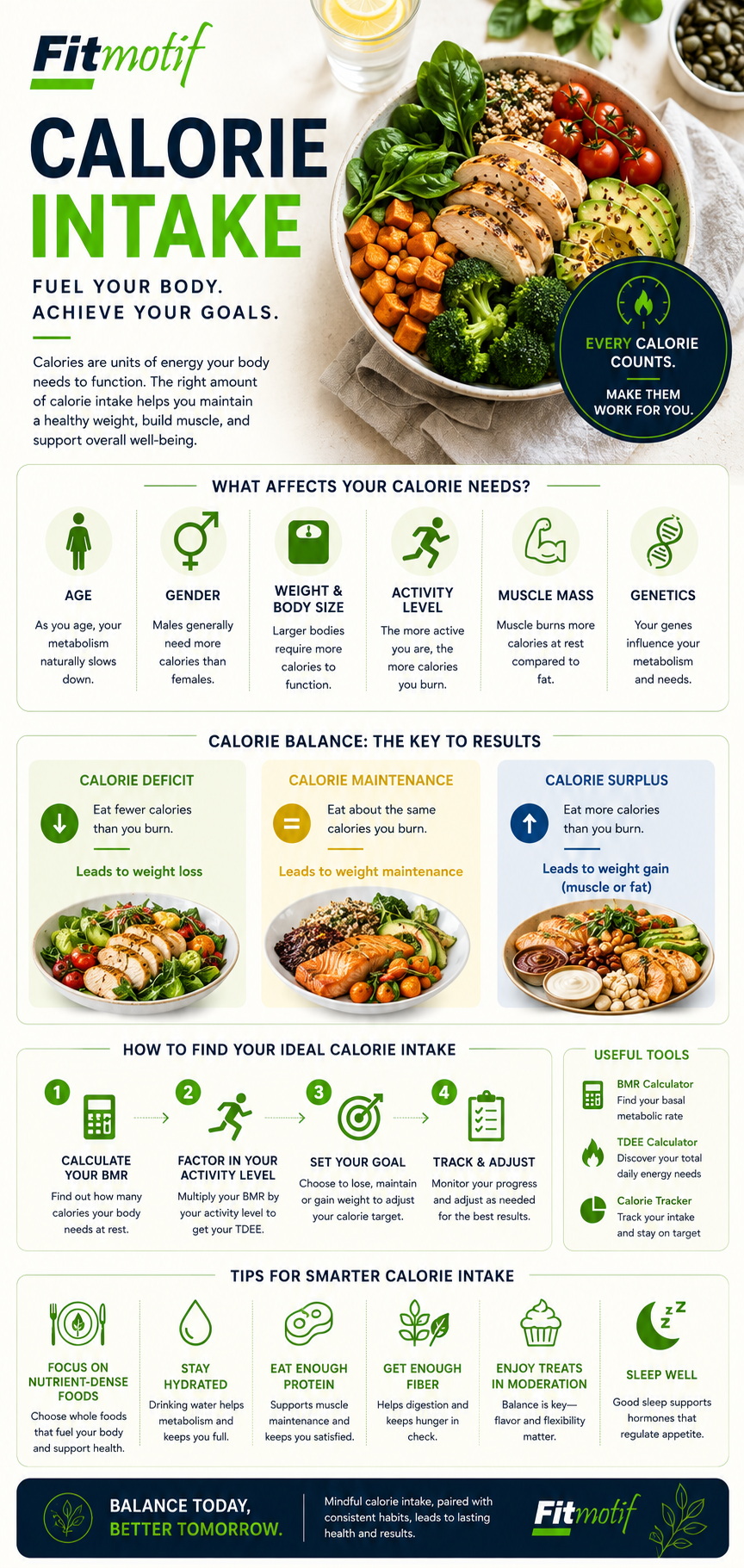
The standard method for calculating your daily calorie intake requirement involves two steps. First, you estimate your Basal Metabolic Rate (BMR) — the calories your body burns at complete rest just to sustain basic life functions. Second, you multiply that figure by an activity factor to get your Total Daily Energy Expenditure (TDEE), which represents your maintenance calorie level: the amount you need to eat to hold your current weight steady. The most widely validated formula for BMR in adults is the Mifflin–St Jeor equation.
| Step | Men | Women |
|---|---|---|
| BMR Formula | (10 × kg) + (6.25 × cm) − (5 × age) + 5 | (10 × kg) + (6.25 × cm) − (5 × age) − 161 |
| Sedentary TDEE | BMR × 1.2 | |
| Lightly Active TDEE | BMR × 1.375 | |
| Moderately Active TDEE | BMR × 1.55 | |
| Very Active TDEE | BMR × 1.725 | |
| Extra Active TDEE | BMR × 1.9 | |
For example, a 35-year-old woman weighing 68 kg and standing 165 cm tall has a BMR of approximately 1,441 kcal/day using the Mifflin–St Jeor formula. If she is moderately active, her TDEE is 1,441 × 1.55 = roughly 2,233 kcal/day. That is her personal daily calorie intake requirement for weight maintenance. Working these numbers out by hand is straightforward but easy to miscalculate — our calorie calculator handles the maths instantly and also breaks down your macronutrient targets if needed.
Setting Calorie Goals: Weight Loss, Muscle Gain, and Maintenance
Once you know your TDEE, setting a calorie target for a specific goal is straightforward. For sustainable fat loss, a deficit of 300–500 kcal below your TDEE is the evidence-backed sweet spot — enough to drive consistent fat loss of 0.3–0.5 kg per week without triggering the metabolic adaptations (hunger hormone surges, metabolic slowdown) that come with aggressive restriction. Going below 1,200 kcal/day for women or 1,500 kcal/day for men is not recommended without medical supervision, as it risks nutrient deficiencies and accelerates muscle loss — which lowers your TDEE permanently.
For muscle building, a modest surplus of 200–300 kcal above TDEE supports lean mass growth without excessive fat gain. The composition of those extra calories matters — adequate protein (1.6–2.2 g per kg of body weight) is essential for muscle protein synthesis, and this should be factored into your total alongside your calorie target. For maintenance, eating at TDEE with a focus on nutrient-dense whole foods and adequate protein is the most sustainable long-term approach. Whichever goal applies to you, revisiting your daily calorie intake requirement every 4–6 weeks — or whenever your weight changes significantly — keeps your target accurate as your body changes.
| Goal | Calorie Target | Expected Result |
|---|---|---|
| Fat Loss | TDEE minus 300–500 kcal | 0.3–0.5 kg fat loss per week |
| Aggressive Fat Loss | TDEE minus 500–750 kcal | 0.5–0.75 kg per week; higher muscle loss risk |
| Maintenance | At TDEE | Stable body weight |
| Lean Muscle Gain | TDEE plus 200–300 kcal | Slow lean mass gain, minimal fat |
| Bulk (Mass Gain) | TDEE plus 300–500 kcal | Faster muscle gain with some fat gain |
Not sure where your TDEE sits? Our calorie calculator calculates your maintenance calories and automatically applies the right adjustment for your chosen goal — fat loss, muscle gain, or maintenance.
Calorie Needs During Pregnancy: Trimester-by-Trimester Guide
Pregnancy is one of the few life stages where calorie needs change in a structured, research-defined way — and where getting the numbers right has direct consequences for both mother and baby. The common phrase "eating for two" is one of the most persistent nutrition myths: in reality, the additional calorie requirement during most of pregnancy is modest and highly trimester-dependent. A calories pregnancy calculator takes your pre-pregnancy weight, height, age, and activity level to give you a personalised figure — but the trimester framework below applies to most healthy pregnancies.
| Trimester | Additional Calories/Day | Key Nutritional Focus |
|---|---|---|
| First (Weeks 1–12) | ~0–100 kcal extra | Folate, iron, vitamin B12, iodine |
| Second (Weeks 13–26) | ~340 kcal extra | Calcium, vitamin D, omega-3, protein |
| Third (Weeks 27–40) | ~450 kcal extra | Iron, protein, omega-3, vitamin K |
These figures are drawn from recommendations by the NHS and the American College of Obstetricians and Gynecologists (ACOG). It is worth noting that these additional calorie figures assume a healthy pre-pregnancy weight. Women who were underweight before pregnancy may need more; those who were overweight may need a different adjustment entirely, guided by their healthcare provider. A dedicated calories pregnancy calculator accounts for pre-pregnancy BMI and current trimester to give a more personalised figure than population averages can.
Quality matters enormously during pregnancy — perhaps more than at any other life stage. An additional 340 kcal in the second trimester is a relatively small amount, roughly equivalent to a small handful of nuts and a yoghurt, so every extra calorie should come from nutrient-dense sources. Protein supports foetal tissue development; calcium and vitamin D build bone; iron prevents anaemia; and omega-3 fatty acids (particularly DHA) support brain and eye development. Processed, calorie-dense but nutrient-poor foods meet the calorie target on paper while leaving critical nutritional gaps. Discuss your full nutrition plan with a midwife or registered dietitian, especially in the third trimester when calorie and micronutrient demands are highest.
Breastfeeding extends the elevated calorie need beyond delivery. Most guidelines recommend an additional 330–400 kcal per day while exclusively breastfeeding, gradually tapering as the baby begins eating solid food. Women who breastfed before returning to pre-pregnancy weight should not aggressively restrict calories while nursing, as this can reduce milk supply and affect nutritional quality. A structured wellness and nutrition programme designed for postpartum recovery can bridge the gap between raw calorie targets and practical, sustainable eating.
What Affects Your Daily Calorie Intake Requirement Beyond the Formula
Calorie calculators give you an excellent starting point, but they cannot fully account for individual biological variation. Several factors can cause your real calorie needs to deviate meaningfully from any formula's prediction — and understanding them helps you calibrate your intake based on real-world feedback rather than mathematical estimates alone.
| Factor | Effect on Calorie Needs |
|---|---|
| Muscle mass | Higher lean mass = higher resting calorie burn. Two people of identical weight with different body composition have different calorie needs. |
| Thyroid function | Hypothyroidism can reduce metabolic rate by 15–40%; hyperthyroidism raises it. Either condition requires medical management, not just dietary adjustment. |
| Gut microbiome | Emerging research shows microbiome composition affects calorie extraction efficiency from food — the same meal yields different usable energy for different people. |
| Sleep quality | Poor sleep disrupts ghrelin and leptin — the hunger and satiety hormones — increasing appetite and calorie intake the following day, often by 300–500 kcal. |
| Stress and cortisol | Chronic stress elevates cortisol, which promotes fat storage (especially visceral fat) and increases cravings for calorie-dense foods. |
| Medications | Certain antidepressants, corticosteroids, antipsychotics, and diabetes medications can affect appetite, metabolic rate, or fat storage independently of calorie intake. |
| NEAT (Non-Exercise Activity Thermogenesis) | Fidgeting, posture, and daily movement outside structured exercise can differ by up to 2,000 kcal/day between individuals of similar size. |
Common Calorie Counting Mistakes That Undermine Your Results
Even people who track their food diligently often make systematic errors that throw their calorie data significantly off. The most common is underestimating portion sizes. Research consistently shows that people — including trained dietitians — tend to underestimate calorie content by 20–40% when estimating by eye. Using a kitchen scale rather than volumetric measures (cups and spoons) dramatically improves accuracy, particularly for calorie-dense foods like oils, nut butters, cheese, and grains.
A second frequent mistake is ignoring liquid calories. Coffees, juices, smoothies, sports drinks, and alcohol can add several hundred calories to a day without registering as "food" in most people's mental accounting. A single large latte with whole milk and a shot of syrup can contain 250–350 kcal — equivalent to a small meal. Alcohol is particularly problematic because it provides 7 kcal per gram (more than carbohydrates and protein, less than fat) while offering no nutritional value and actively suppressing fat oxidation while it is being metabolised.
The third pitfall is using the same calorie target indefinitely. As body weight changes, so does your daily calorie intake requirement. A 10 kg weight loss meaningfully lowers your TDEE — sometimes by 200–300 kcal/day — which is why fat loss tends to slow or stall after initial progress even when adherence hasn't changed. Recalculate your calorie target every 4–6 weeks or after any significant weight change using our calorie calculator to keep your targets accurate.
Practical Steps: From Knowing Your Calorie Number to Actually Using It
The most useful immediate action is calculating your personal daily calorie intake requirement using our calorie calculator. Enter your age, sex, height, weight, and activity level, and you will get your BMR, TDEE, and a suggested calorie target based on your goal. From there, start tracking your food intake for at least two full weeks before drawing any conclusions — daily weight fluctuations driven by water retention, sodium, and hormonal variation can mask real fat loss or gain entirely in the short term. Weekly average weight trends over 14+ days are far more informative than any individual weigh-in.
Prioritize protein at every meal — not only does it preserve muscle during a calorie deficit, its high thermic effect means your body burns more energy digesting it compared to carbohydrates or fats, effectively giving you a small metabolic boost for free. Fill the remaining calories with nutrient-dense carbohydrates and healthy fats. If you are pregnant or breastfeeding, use the trimester-based figures in this article alongside guidance from your healthcare provider — and consider a dedicated calories pregnancy calculator to personalize your targets beyond the population averages. Above all, treat your calorie number as a living figure: recalculate regularly, track real-world results, and adjust based on what your body is actually doing rather than what the formula predicted.
Frequently Asked Questions About Daily Calorie Intake
What is the typical daily calorie intake for adults?
The typical daily calorie intake for adult women ranges from 1,600 to 2,400 calories per day, and for adult men from 2,000 to 3,000 calories per day, depending on age, height, weight, and activity level. These are general guidelines from the Dietary Guidelines for Americans. Your personal daily calorie intake requirement will differ — use a calorie calculator for a precise figure based on your body and lifestyle.
How many extra calories do you need during pregnancy?
During the first trimester, most women need little to no additional calories above their pre-pregnancy intake. In the second trimester, around 340 extra calories per day are recommended, rising to approximately 450 extra calories per day in the third trimester. A calories pregnancy calculator can personalise these figures based on your pre-pregnancy weight, height, age, and activity level.
How do I calculate my daily calorie intake requirement?
Your daily calorie intake requirement is calculated by first finding your Basal Metabolic Rate (BMR) — the calories your body burns at rest — and then multiplying it by an activity factor to get your Total Daily Energy Expenditure (TDEE). TDEE is your maintenance calorie level. To lose weight, eat below TDEE; to gain muscle, eat modestly above it. A calorie calculator automates this using your age, sex, height, weight, and activity level.
How many calories should I eat to lose weight?
A sustainable calorie deficit for weight loss is 300–500 calories below your Total Daily Energy Expenditure (TDEE). This typically produces fat loss of 0.3–0.5 kg (0.5–1 lb) per week without significant muscle loss or metabolic slowdown. Very low calorie diets below 1,200 calories for women or 1,500 for men are not recommended without medical supervision, as they risk nutritional deficiencies and metabolic adaptation.
Does calorie need change with age?
Yes. The daily calorie intake requirement generally decreases with age, primarily because muscle mass declines with age (sarcopenia), reducing the number of calories burned at rest. Most adults see their calorie needs drop by roughly 100–200 calories per decade from their 30s onward, though staying physically active and maintaining muscle mass slows this decline significantly.
What is the difference between calories and kilocalories?
In everyday nutrition, the word "calorie" almost always refers to a kilocalorie (kcal) — 1,000 times the scientific unit called a calorie. When a food label says a meal contains 500 calories, it means 500 kilocalories. The terms are used interchangeably in popular usage, so there is no practical difference when tracking your typical daily calorie intake.
Understanding your daily calorie intake requirement is not about obsessing over numbers — it is about giving yourself accurate information so your effort produces results. The typical daily calorie intake figures published by health authorities give you a starting framework; your personal TDEE, calculated from your actual body measurements and activity level, gives you a target you can genuinely act on. Whether you are managing your weight, building muscle, or navigating the nutritional demands of pregnancy, the right calorie number — applied consistently and recalibrated as your body changes — is the foundation everything else is built on. Start with our free calorie calculator and turn a general guideline into a plan that actually fits you.