
Basal Metabolic Rate Explained: What Your BMR Means for Weight & Health

You've probably wondered why two people can eat the same food and exercise the same amount yet get completely different results. A huge part of the answer lives in three letters: BMR. Your basal metabolic rate is the engine running silently beneath every calorie decision you make — and most people have never actually measured it. Understanding your bmr metabolic rate doesn't just satisfy curiosity; it gives you a precise, science-backed starting point for any fat-loss, muscle-building, or maintenance goal.
What Is Basal Metabolic Rate — And Why Does It Matter?
Basal metabolic rate (BMR) is the number of calories your body burns per day while in a state of complete rest — no movement, no digestion, no stress. It represents the minimum energy required to keep you alive: heart beating, lungs breathing, kidneys filtering, cells repairing. Contrary to what many people assume, the majority of your daily calorie burn — roughly 60–75% — comes not from exercise, but from this invisible, non-stop biological maintenance. That's why getting your bmr metabolic rate right is the most important number to understand before setting any calorie goal.
BMR is not a fixed number. It shifts with your age, body composition, hormonal profile, and health status. Two people of identical height and weight can have meaningfully different BMRs depending on how much of that weight is lean muscle versus fat tissue. Muscle is metabolically active — it burns calories even at rest. Fat tissue burns very little. This is why an athlete and a sedentary person of the same weight will need very different calorie intakes, and why a basal metabolic rate calculator that factors in your body composition gives you more actionable data than a generic chart ever could.
The Basal Metabolic Rate Formula: How BMR Is Calculated
There are several equations used to estimate BMR, each developed through clinical research and validated against measured energy expenditure. The two most widely used are the Mifflin–St Jeor equation and the older Harris–Benedict equation. Both use the same four inputs — weight, height, age, and biological sex — but differ slightly in their coefficients, leading to small but sometimes meaningful differences in output.
| Formula | Men (calories/day) | Women (calories/day) | Accuracy |
|---|---|---|---|
| Mifflin–St Jeor | (10×kg) + (6.25×cm) − (5×age) + 5 | (10×kg) + (6.25×cm) − (5×age) − 161 | Most accurate for most adults |
| Harris–Benedict (revised) | (13.397×kg) + (4.799×cm) − (5.677×age) + 88.362 | (9.247×kg) + (3.098×cm) − (4.330×age) + 447.593 | Widely used, slightly less precise |
| Katch–McArdle | 370 + (21.6 × lean body mass in kg) | Most accurate with body fat data | |
The Mifflin–St Jeor basal metabolic rate formula is the current gold standard recommended by the Academy of Nutrition and Dietetics. In studies comparing predicted BMR to measured resting energy expenditure, it consistently outperforms other equations for the general population. The Katch–McArdle formula is more precise for athletes and individuals who know their body fat percentage, since it uses lean body mass directly — but most people don't have access to that data without specialist testing. Our free BMR calculator uses the Mifflin–St Jeor equation as its default and gives you instant results.
Skip the manual maths — use our online metabolic rate calculator to get your BMR and Total Daily Energy Expenditure in seconds, with both metric and US unit support.
BMR vs TDEE: The Number That Actually Drives Your Results
BMR is your biological floor — the calories you'd burn lying still in bed all day. But nobody actually does that. Your real-world calorie needs are captured by your Total Daily Energy Expenditure (TDEE), which is simply your BMR multiplied by an activity factor. TDEE is the number you should use to set your calorie targets, not BMR alone. Eating at your TDEE maintains your current weight; eat below it and you lose weight; eat above it and you gain weight. Understanding this relationship turns your basal metabolic rate calculator result from an interesting number into a genuinely actionable tool.
| Activity Level | Description | Multiplier |
|---|---|---|
| Sedentary | Little or no exercise; desk job | BMR × 1.2 |
| Lightly Active | Light exercise 1–3 days/week | BMR × 1.375 |
| Moderately Active | Moderate exercise 3–5 days/week | BMR × 1.55 |
| Very Active | Hard exercise 6–7 days/week | BMR × 1.725 |
| Extra Active | Very hard exercise or physical job | BMR × 1.9 |
Most people significantly underestimate or overestimate their activity level, which throws off their TDEE — and therefore their calorie targets — by hundreds of calories per day. If fat loss has stalled despite eating in a supposed deficit, recalculating your bmr metabolic rate and being more honest about your activity level is often the first diagnostic step worth taking. An accurate TDEE is also directly connected to your BMI, since calorie balance ultimately drives the weight changes that shift your body mass index over time.
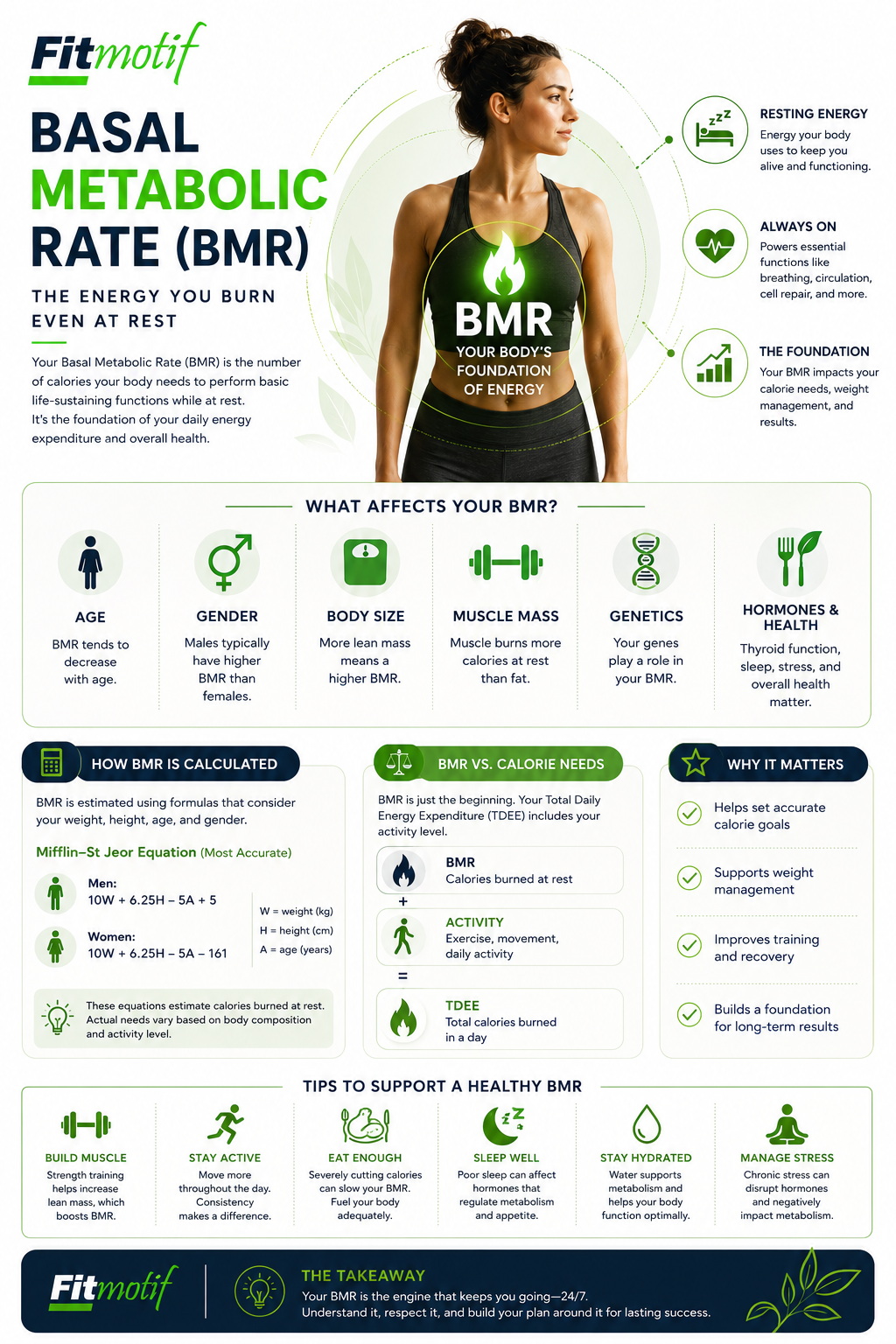
What Affects Your Basal Metabolic Rate? Six Key Drivers
Your bmr metabolic rate is not something you're stuck with — but it does have biological anchors that you need to understand before trying to change it. Several factors influence BMR meaningfully, some fixed and some entirely within your control.
| Factor | Effect on BMR | Controllable? |
|---|---|---|
| Age | BMR declines roughly 1–2% per decade after age 20, mainly due to muscle loss | Partially (resist with strength training) |
| Biological Sex | Men typically have 5–10% higher BMR due to greater lean mass and lower body fat | No |
| Muscle Mass | Each kg of muscle burns ~13 kcal/day at rest vs ~4.5 kcal/day for fat | Yes — resistance training builds muscle |
| Body Size | Larger bodies generally have higher absolute BMR due to more tissue to maintain | Yes — changes with weight |
| Genetics | Inherited variation accounts for up to 40% of individual BMR differences | No |
| Hormones | Thyroid hormones (T3/T4), cortisol, insulin, and sex hormones all regulate metabolic rate | Partially (lifestyle, medical treatment) |
Thyroid function deserves special mention. The thyroid gland produces hormones that act as the body's metabolic accelerator. Hypothyroidism (underactive thyroid) can reduce BMR significantly — sometimes by 30–40% in severe cases — causing unexplained weight gain, fatigue, and cold intolerance. If you feel your results don't match what a basal metabolic rate calculator predicts, a thyroid panel with your doctor is a sensible next step. The NHS and NIH both provide reliable information on thyroid-related metabolic issues.
Using a Basal Metabolic Rate Calculator: What the Numbers Tell You
An online metabolic rate calculator does the heavy lifting of the basal metabolic rate formula for you. Enter your age, sex, height, and weight, and it returns your BMR in calories per day. The real value, though, comes in the next step: applying your activity multiplier to get your TDEE, and then setting a calorie target relative to that number. For fat loss, a deficit of 300–500 calories below TDEE is the evidence-based sweet spot — aggressive enough to produce measurable results, conservative enough to protect muscle mass and metabolic rate.
One mistake people make is eating below their BMR in an effort to lose weight faster. This is counterproductive for two reasons. First, your body interprets severe calorie restriction as a threat and responds by downregulating metabolic processes — a phenomenon known as adaptive thermogenesis, which can reduce BMR by up to 15% over time. Second, severe restriction accelerates muscle loss, which directly lowers your BMR permanently. Eating at or above your BMR — and adjusting from your TDEE — protects metabolic health for the long term. Use our basal metabolic rate calculator to find your true floor, then build your calorie plan from there.
Want a full picture? Pair your BMR result with our BMI calculator to see how your weight-to-height ratio relates to your metabolic baseline — and what your healthy weight range looks like at your height.
How to Increase Your Basal Metabolic Rate: What Actually Works
The most reliable long-term strategy for raising your bmr metabolic rate is building lean muscle through progressive resistance training. Muscle is the only tissue in the body that significantly increases resting calorie burn over time. A meaningful gain in lean mass — even 2–3 kg — can add 25–40 calories to your daily BMR, which compounds significantly over months and years. This is why strength training is central to nearly every credible weight management programme, even for people whose primary goal is fat loss rather than muscle gain.
Beyond muscle building, several daily habits support a healthy metabolic rate. Eating enough protein has a meaningful thermic effect — the body burns more calories digesting protein (20–30% of protein calories consumed) than carbohydrates or fats. Staying well-hydrated supports cellular metabolism. Getting 7–9 hours of quality sleep regulates the hormones — ghrelin, leptin, cortisol — that directly influence how efficiently your body uses energy.
Where BMR Falls Short — And What to Use Alongside It
Like any single metric, the basal metabolic rate formula has real limitations. The Mifflin–St Jeor equation was validated on a population of moderately healthy adults and performs less accurately for people at the extremes of body composition — very lean athletes, people with severe obesity, or those with significant hormonal conditions. The standard formula also doesn't distinguish between fat mass and lean mass, which means a lean, muscular individual and a less active individual of the same weight and height will get the same BMR estimate, despite having very different real-world metabolic rates.
For most people, the formula is accurate within roughly 10%, which is close enough to make it genuinely useful for setting initial calorie targets. The practical workaround for higher precision is to use BMR as a starting point, track your actual weight change over 2–4 weeks at a target calorie level, and adjust based on real results. If you're losing weight faster than expected, your real BMR may be lower than calculated; if slower, it may be higher. This feedback loop is far more accurate than any formula can be, because it's based on your actual body rather than a population average.
Practical Steps: Turning Your BMR Into a Real Action Plan
The most useful thing you can do right now is calculate your actual basal metabolic rate. Use our online metabolic rate calculator to get your personalized BMR number, apply your honest activity multiplier to find your TDEE, then set a calorie target 300–500 below TDEE if your goal is fat loss, or 200–300 above TDEE if you're looking to build muscle. Track your food intake for at least two weeks before drawing any conclusions — short-term fluctuations due to water retention, sodium, and hormonal cycles make day-to-day weight readings unreliable. Trends over 14+ days are what matter.
Revisit your bmr metabolic rate calculation every 4–6 weeks, or any time your weight changes by more than 3–4 kg, since your BMR shifts with your body weight. Pair it with your BMI to track how your weight-to-height ratio evolves alongside your calorie strategy. Used together, these two numbers give you a clear, evidence-backed picture of where you stand metabolically — and what to do next.
Frequently Asked Questions About Basal Metabolic Rate
What is basal metabolic rate (BMR)?
Basal metabolic rate (BMR) is the number of calories your body needs to perform essential life-sustaining functions — breathing, circulation, cell production, and temperature regulation — while in a state of complete rest. It represents the minimum energy your body requires to stay alive and accounts for roughly 60–75% of your total daily calorie burn.
What is the most accurate basal metabolic rate formula?
The Mifflin–St Jeor equation is widely regarded as the most accurate basal metabolic rate formula for most adults. For men: BMR = (10 × weight in kg) + (6.25 × height in cm) − (5 × age) + 5. For women: BMR = (10 × weight in kg) + (6.25 × height in cm) − (5 × age) − 161. The older Harris–Benedict equation is also commonly used but slightly less precise for modern populations.
How does a basal metabolic rate calculator work?
A basal metabolic rate calculator uses your age, biological sex, height, and weight as inputs and applies either the Mifflin–St Jeor or Harris–Benedict formula to estimate how many calories your body burns at rest per day. Many online metabolic rate calculators also multiply your BMR by an activity factor to give you your Total Daily Energy Expenditure (TDEE).
What is the difference between BMR and TDEE?
BMR (basal metabolic rate) is the calories your body burns at complete rest — the biological baseline. TDEE (Total Daily Energy Expenditure) is your BMR multiplied by an activity factor that accounts for your movement throughout the day. TDEE is the number most relevant for setting calorie targets for weight loss, maintenance, or muscle gain.
Can you increase your basal metabolic rate?
Yes. The most effective way to raise your bmr metabolic rate over time is to build lean muscle mass through resistance training, since muscle tissue burns more calories at rest than fat tissue. Eating adequate protein, staying well-hydrated, and getting quality sleep also positively influence metabolic hormones. Crash dieting has the opposite effect — severe calorie restriction can lower BMR significantly through a process called adaptive thermogenesis.
How many calories should I eat based on my BMR?
You should never eat below your BMR for extended periods — doing so deprives your body of the energy it needs just to function. Your actual calorie target should be based on your TDEE (BMR × activity multiplier). To lose weight sustainably, a deficit of 300–500 calories below TDEE is the standard recommendation. Use a basal metabolic rate calculator to find your BMR first, then apply your activity level to get your TDEE.
Your basal metabolic rate is the single most important number in any calorie strategy — yet most people have never calculated it. The basal metabolic rate formula gives you a science-backed starting point; your activity level turns it into a real daily calorie target; and honest tracking closes the loop. Whether your goal is fat loss, muscle gain, or simply sustaining the results you've already earned, knowing your bmr metabolic rate puts you in control of the numbers rather than guessing at them. Start with our free online metabolic rate calculator and give yourself the data you actually need.